 Yoga classes have begun to polarise. From the fast and sweaty vinyasa flow and Ashtanga yoga, to the restorative and Yin yoga classes that have emerged. They seem to be on two ends of a wide spectrum of modern postural yoga classes.
People turn to yoga for a range of different reasons. Perhaps you've come to it to feel stronger or more flexible, or you enjoy the heat and sweat that it can build. Perhaps you enjoy the stillness and calm that it offers, or the good nights sleep it gains you. You may have an injury or pain that you are looking to sort out, or perhaps you just want that elusive feeling of wellbeing. They are all good reasons to practice yoga, and finding the right approach for your practice is more than just the immediate feeling it leaves you with. Your practice should leave you feeling better than when you started, and progressively better in the long term. You may be surprised that I even need to state this. But I regularly speak to practitioners and even yoga teachers who switch between two extreme styles of yoga practice in an effort to keep themselves balanced. Taking a strong vinyasa class supplemented with a Yin or restorative class seems a simple contradiction in approach. It's nice to change pace and explore from time-to-time. But to pursue the challenge and energy which then leaves you needing restoration to enable you to continue this cycle seems worth reflecting on. It is a cycle we often undertake in life which we then replicate on our yoga mats. Yoga practice is for the long term. It should support your primary aims as well as deepening your sense of internal balance with consistent practice. The balance of yoga doesn't begin on the mat, it beings before you get there, with your intention and choice of how to practice. Back to YogaSpace Homepage
0 Comments
They aren't entirely sure why, as you don't get puffed in the same way that you do doing more traditional cardiovascular exercise. But research suggests it is true and believe it is due to the combination of exercise and stress reduction.
According to the research, yoga leads to weight loss, lowers cholesterol and cuts blood pressure. And it even helps you quit smoking. The research involved 2,700 people and also found that regular yoga practice reduced blood pressure 3x more effectively then taking pills. "Yoga may provide the same benefits in risk factor reduction as traditional physical activity such as cycling or brisk walking". Says researcher Myriam Hunink of Erasmus University and Harvard University. Maureen Talbot of the British Heart Foundation said "any physical activity that can help reduce the risk of cardiovascular disease should be encouraged, and the benefits of yoga on emotional health are well established". Brilliant, get yourself to a class or start your home practice today! See our class schedule here and get in touch to find out more. Back to the Bristol YogaSpace homepage.  The time for good intentions is all around us. Perhaps we want to become fitter, more flexible, leaner, more creative, more focused, happier? All of these are possible. And to help, here are my top 5 tips for getting started. (Also read our GETTING STARTED page for new students.)
1) Start small - Pick one thing. A new class? Or a mini yoga practice at home that you can do every day just for 10 minutes (just pick 3 or 4 yoga postures and do that for a couple of months). Don't choose both of these, just choose one thing as that is effort enough. Focus on getting the habit started, rather than the results that you want to get from doing it. 2) Be realistic - pick the time that you can do every day or every week that is sensible and that can work for you more often than not. Then pick a class or a short daily practice, 3 or 4 poses that you think you can do and that you will enjoy. Your focus should be on getting the habit ingrained. The rest will follow. 3) Get started - the main thing is that you do it. It doesn't matter if you do it well, or if you have a cold so need to go gently, or that it is raining and cold and you don't fancy going to your class. The main thing is to get started, do it, and do it in a way that you can stick to. Get yourself on your yoga mat every week or every day. 4) Tell someone your getting started - this will help you make the commitment and increase your likelihood of doing it! 5) Don't miss two in a row. If you need to miss one, then ok. Try not to miss two in a row as then the habit is broken and all your good effort may not come to fruition. Keep going, even if only gently if your under the weather. If your away, then try to make up the class or the practice in another way that still counts. Good luck with getting your new yoga practice in place. The benefits will be worth it, all you need to do it turn up and do it :-). Happy new year!  I've recently been inspired by reading about minimalism as an approach to living. I've been enjoying how it reflects many values that I hold close, and that I've been cultivating through my study and practice of yoga. It has also inspired me to have a really good clear out of my home!
The idea of living simply with less to enjoy life more is one that has taken more prominence for me since becoming a yoga teacher. I teach viniyoga - yoga that is applied carefully and adapted to suit those who are participating. Viniyoga embodies a minimalist approach to yoga practice. It doesn't require a super heated yoga studio, or any special kit (no blocks, belts, bolsters or even mats required). Nor does it require a certain level of fitness or skill to participate. All you need is you, your body, your breath, and your attention. In fact this is why it initially appealed to me. I wanted to start practicing yoga at home but found the foam blocks, folding chair, bolster, strap and bricks used in class rather unwieldy and off-putting to home practice, and questioned how essential they really were. Upon discovering the simplicity of viniyoga I was hooked, home practice became encouraged, and there has been no looking back. I often do use a sticky yoga mat, but at home I'm equally happy practicing on a carpet (or even floorboards if necessary as I did last week when I was away but it's a little less comfortable). I use my body's own weight to create resistance to help strengthen and energise as I practice the various postures (asana) of yoga. Viniyoga has a minimalist approach to the repertoire of asana usually practiced. At it's core there are a carefully selected set of primary asana, each serving an important purpose. These asana are gradually explored in further and further depth, with a deepening emphasis on breath and focus and techniques around these as the practice advances. This makes it a very accessible form of yoga practice as you can deepen your yoga practice and continue to develop without the need for a gymnast's or dancer's body. Let's face it, if you started practicing yoga as an adult, that isn't a realistic ambition for most people. And beyond the daily bodywork and breathwork to maintain and develop our health, yoga cultivates mindful compassionate living, minimising the dependence on material attributes in our lives so that we have space to spend each day in an enjoyable, meaningful way. A wonderful way to live with amazing potential. Back to the YogaSpace homepage. 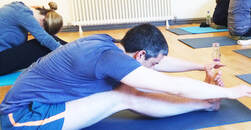 Running the Bristol Half Marathon this Sunday?
What you learn on the yoga mat either at your group class or in your own home yoga practice can be invaluable to help keep you injury free, focused, motivated, energised and able to stay the distance. Here are some top-tips: 1) Tall posture Yoga practice often starts by standing on the mat, focusing on standing with awareness, with attention and length in the spine, having an open chest, and then relaxing your shoulders and breathing deeply. Bring this feeling of readiness yet relaxation into your pre-run preparation and take some deep breathes to stay focused and relaxed. Stand with both feet evenly supporting you and be aware of the shift of balance from side to side of the feet and body. This awareness of balance can carry on through into your running to help keep you centred and grounded for the duration of the run. 2) Stay aware to prevent injury It is easy to become part of the crowd and lose your internal awareness, meaning your perhaps not listening to your body and maybe accumulating tension into your running. This is when injuries are far more likely. Stay focused and aware of your running and how your body is responding. Keep aware of how your breathing is, and try to relax and let go of any tension as you notice it coming into the body. During the run, every 10 minutes or so, spend 10 breaths checking that you are breathing well, with a good exhalation, that your shoulders and body are relaxed, and that your posture isn't starting to collapse as you become tired. Reenergise yourself and keep your focus going. 3) Open your chest to breathe Breathing properly is very important to ensure your body is working at its optimum, and many people only use a portion of their full breath, meaning their bodies have to work harder. As you tire, everything wants to collapse downwards, including your chest and shoulders. Or perhaps you become tense and your full capacity for breathing 'seizes up' as you will yourself on. Keep your chest open, shoulders back and relaxed, shoulder blades down, arms and hands relaxed. Maintaining this openess will enable optimal breathing. 4) Take time to exhale Your yoga practice will have taught you to exhale completely, and this takes time and practice. If you become out of breathe during running, it usually is because your not breathing out deeply enough. Focus on your exhale, breathe out from the belly drawing your belly button in towards the spine, take a few deeper exhales and than relax into a breathing rhythm that allows full exhalation. 5) Some Downward Facing Dog After the run, fully stretching will help your recovery and leave you in less discomfort the next day. Include some time spent in downward facing dog as this can be great for stretching your calves, hamstrings and your back. Stay in the pose for at least 8 full breathes (breathing slowly), longer if comfortable for you. Each inhalation spend time lengthening the spine and extending the hips away from the shoulders, each exhalation allowing the legs to take a little more of the stretch. Taking some time to relax and stretch here to help your recovery from the run. (Not advis Most of all, enjoy your run and good luck! Back to YogaSpace homepage >
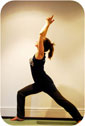 There are many inspiring stories of how practicing yoga has helped to support people with serious health problems back to full health. Here is a wonderful account of an NBA basketball player struck down with a serious kidney condition which resulted in a kidney transplant, and how his dedicated practice of yoga helped save his life and his career as a professional athlete...
Read more in this inspiring post by Trevor Kearney... Back to homepage >  Yoga is more popular than ever before but people are noticing (including Radio 4 who broadcast 'Corporate Karma' last week) how some of the traditional values and teachings of yoga are being left behind in its popularity.
When you think of yoga do you immediately think about someone doing something rather bendy that looks impossible to most of us? About the pursuit of physical health? Or do you think about sitting in meditation? About having the stability to sit and connect with something beyond your everyday persona? Yoga is innovating itself in our modern, Western world. It is becoming accessible to many by appealing to the desire to be fitter and healthier. It is becoming big business for some with brands such as Bikram Yoga and Lulu Lemon making £millions for the shareholders. But in the quest for popularity and profit, are the compromises ever going to allow yoga's true value to shine through? Physical pursuits for fitness are everywhere. Even the smallest village has a keep fit class, probably even a yoga class at the village hall once a week. In cities there are numerous yoga centres all offering an array of quick benefits and fitness promises. We are appealing to what people want. Yoga provides this but it also has far more potential than offering a quick feeling of calm and energy before heading home after a days work. This is just the tip of a rather huge iceburg. The teachings do make you feel good, we can all experience that, but that isn't by any means it. The teachings are ancient and teach about a path which if followed diligently, with a true guide, can lead to an ultimate reward far beyond any material posession or physical health. Along the way you'll learn about yourself and the world you live in. Some call it a spiritual path, which is a draw to some and offputting to others. The initial feel-good feeling is the thing that captures most of us, and that keeps us coming back for more. The days I don't practice yoga I wish I had, I'm less comfortable and less settled, and less connected with myself and the people around me. Some of yoga's teachings (not taught in the majority of classes) can seem somewhat esoteric. You might be sitting and chanting, or humming, or huffing and puffing with your breath. For us rather reserved British this is all perhaps a little uncomfortable until you get used to it. So the physical form is something we can get more readily, and feel okay with, and then perhaps the rest will come once you start to enquire a little more deeply. I should make it clear that I'm by no means knocking the appeal of the physical fitness and health through yoga, far from it. Although I'm not a supporter of the movement to add yoga as an Olympic sport, competing for who is 'best' at it (which Bikram Choudhury is a keen supporter of) - the physical postures are essential to get many people interested. It is also essential to maintain fitness and health to be strong enough to meditate. But by focusing just on the physical form, it feels a little bit like sitting on a treasure chest full of gold coins, finding a single gold coin and being entirely happy with this, blissfully unaware of the riches right beneath you. Return to YogaSpace homepage |
More blog articles >
Categories
All
Archives
April 2024
|
 RSS Feed
|
Bristol YogaSpace Ltd
Princes Place, Bishopston Just off Gloucester Road Bristol BS7 8NP |
|